Alafia.
An advanced telemedicine and AI diagnostic platform redefining remote healthcare. Empowering medical professionals.
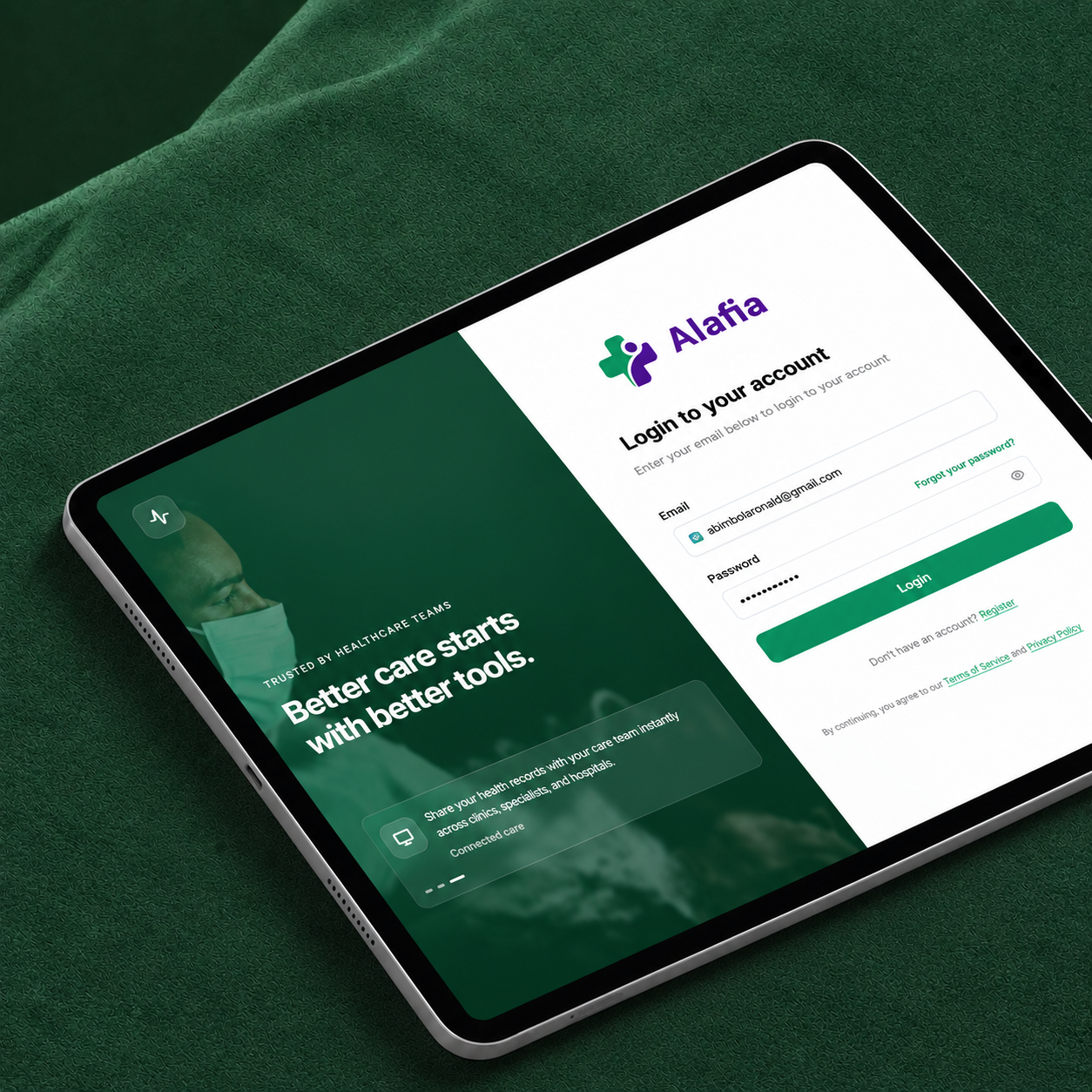
The Engineering Narrative
Alafia is an advanced, interconnected digital health ecosystem that bridges the gap between patients, medical professionals, and hospitals, all powered by state-of-the-art Artificial Intelligence. I led the end-to-end development of the platform, orchestrating a complex microservices architecture that handles high-throughput video consultations, sensitive patient medical records, and real-time AI-driven diagnostic assistance.
Because Alafia serves distinct user bases with highly specialized needs, I engineered a federated frontend architecture utilizing Next.js (App Router) and Redux. We deployed distinct portal applications for Patients, Doctors, Hospitals, and System Administrators, allowing us to independently scale, secure, and update each client interface without cross-contamination of logic or bundle bloat.
The operational heartbeat of the system is the Core Backend, written in Django and PostgreSQL. This centralized nervous system orchestrates authentication, scheduling, EMR (Electronic Medical Records) state management, and real-time WebRTC signaling for telemedicine video calls. To ensure the platform remains hyper-responsive during intensive computational loads, I implemented a distributed task queue utilizing Celery and Redis to handle asynchronous email notifications, data synchronization, and heavy background processing.
What truly sets Alafia apart is its dedicated AI Microservice. Built with FastAPI to maximize asynchronous I/O performance, this standalone service processes medical imagery (such as MRIs and dermatological scans) and returns diagnostic predictions complete with GradCAM visualizations. By abstracting the heavy Machine Learning inference workloads away from the core Django application, the system achieves sub-second diagnostic assistance for doctors in the field, even over constrained networks.
The Ecosystem Actors
Alafia serves a diverse group of users, each with a highly specialized interface connected to a unified central backend.
Patients
Access telemedicine video consultations, receive prescription updates, manage personal EMR history, and interact securely with primary healthcare providers remotely.
Doctors & Specialists
Conduct encrypted WebRTC video visits, review real-time medical charts, and leverage embedded AI tools to generate on-the-fly diagnostic inferences during calls.
Hospitals
A centralized dashboard for managing doctor schedules, admitting patients, reviewing organizational analytics, and securely provisioning new medical staff.


/ Engineered Modules
Architectural
Pillars
A deeper look into the interconnected systems that drive intelligent, scalable telemedicine.
Distributed Multi-Frontend System
Developed four distinct web applications tailored for specific user personas—Patients, Doctors, Hospitals, and Admins. Built with Next.js 16+, React 19, and Tailwind CSS 4, this structure enforces strict data access boundaries and ensures a highly optimized, persona-driven UX.
FastAPI Medical AI Microservice
Abstracted ML inference into a high-performance, containerized microservice. It natively supports TensorFlow and PyTorch model ingestion, generating real-time predictions and GradCAM (Gradient-weighted Class Activation Mapping) visualizations for Brain Tumors, Skin Cancer, and Malaria detection.
Robust Django Core & Celery Workers
The central nervous system operates on a secure Django REST framework handling complex relational data in PostgreSQL. Celery and Redis act as the message broker, safely dispatching resource-intensive background tasks such as compiling medical reports and firing asynchronous multi-channel notifications.
Secure Video Telemedicine (WebRTC)
Integrated end-to-end encrypted video streaming capabilities allowing doctors to seamlessly conduct remote appointments. During these sessions, the UI overlays real-time patient charts and permits instant AI scan analysis directly within the call interface.
